Deel Review 2026: Where It Fits in the Global Hiring Market
An independent editorial review of Deel covering Employer of Record, Global Payroll, and Contractor Management. Honest assessment of strengths, limitations, and pricing from a team that has evaluated 106+ HR tools.
We’ve spent months evaluating 106 recruitment and HR tools for RecruitCompare, analysing pricing structures, feature sets, user reviews, and competitive positioning across every major category. Deel consistently surfaces as the dominant platform in one specific area: international employment infrastructure.
But dominance in a category doesn’t mean it’s the right tool for every company. Deel does a few things exceptionally well and deliberately doesn’t try to do everything else. This review covers what Deel actually delivers across its three core product areas — Contractor Management, Employer of Record, and Global Payroll — where it genuinely excels, where it falls short, and who should be looking at alternatives instead.
The goal here is an honest editorial assessment, not a product endorsement. Deel earns a 4.8/5 on G2 from 4,200 reviews and 4.8/5 on Capterra from 580 reviews. Those ratings are earned, but they don’t tell the whole story.
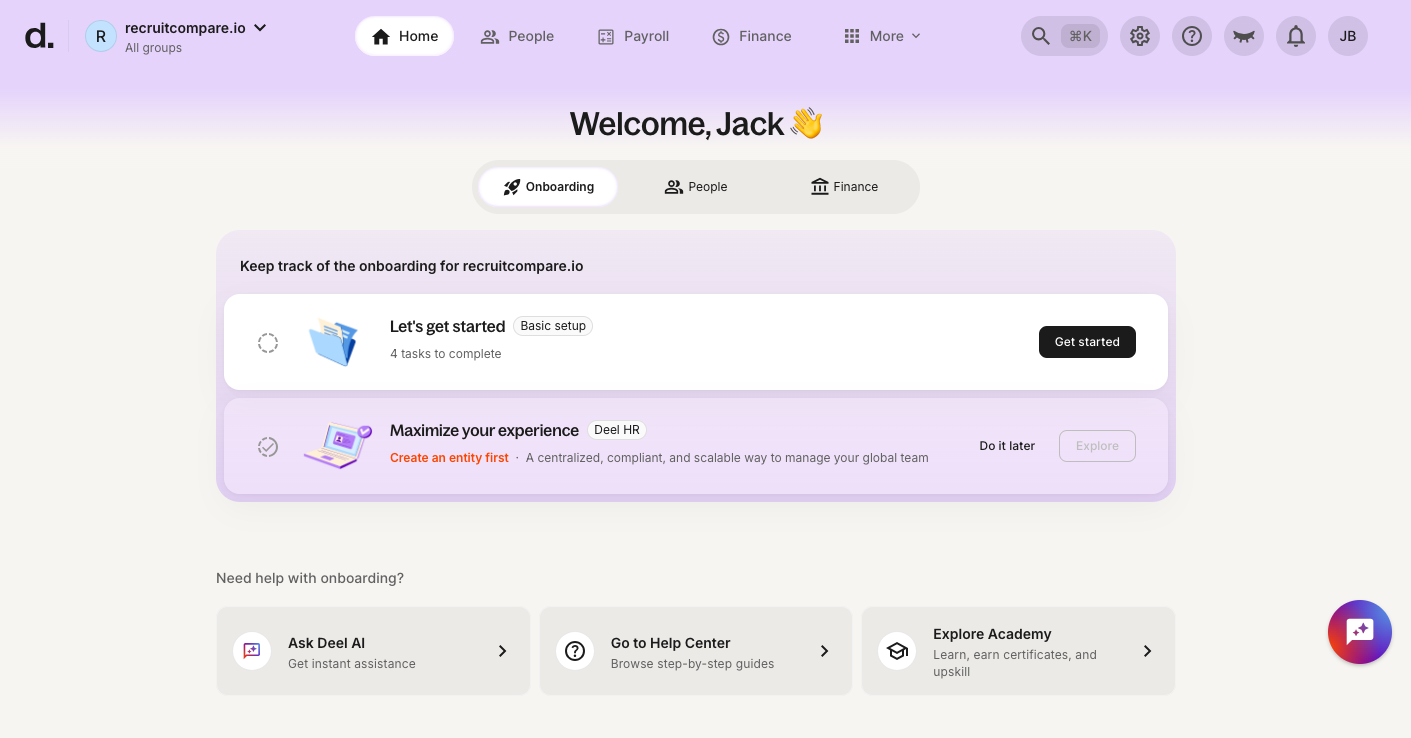 The Deel dashboard after signing up — clean layout with onboarding guidance, quick access to People, Payroll, and Finance sections.
What Deel Does
Deel is a global employment platform founded in 2019 in San Francisco. It operates across 150+ countries and is built around three core product areas, each targeting a different stage of international hiring complexity.
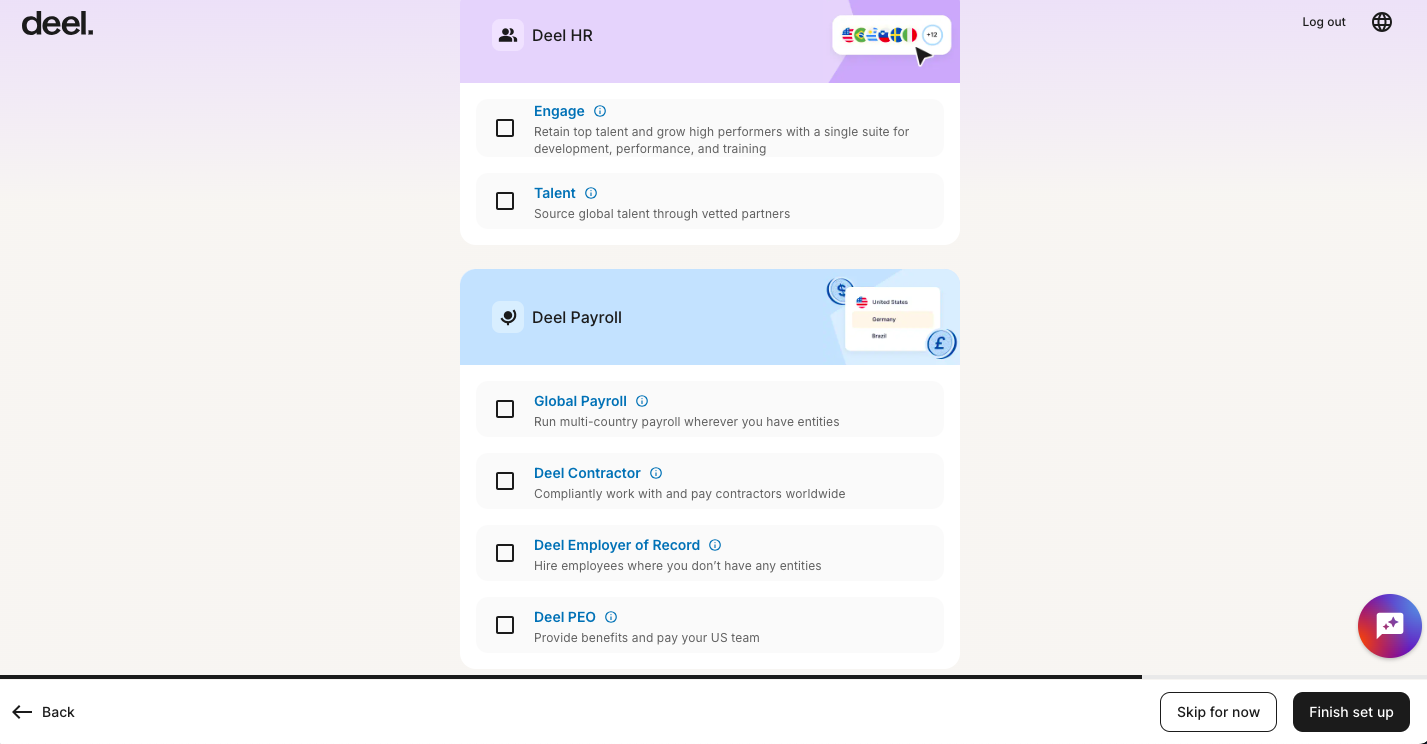 During setup, Deel lets you select which products you need — Contractor Management, EOR, Global Payroll, PEO, and HR modules are all separate selections.
Contractor Management (Free)
Deel’s contractor plan lets companies pay international contractors with no subscription fee. The platform generates compliant contracts per jurisdiction, handles invoicing, and processes payments in multiple currencies. This is Deel’s entry-level product — and the fact that it’s genuinely free is a legitimate differentiator. Deel monetises through currency conversion margins and its paid tiers rather than charging for basic contractor management.
The free plan covers contractor onboarding, contract generation with country-specific clauses, invoice management, and payment processing across 150+ countries. For companies that work with freelancers or contract workers across borders, this removes the compliance guesswork around contractor classification, local tax obligations, and international payment logistics — problems that are surprisingly complex to solve without a dedicated platform.
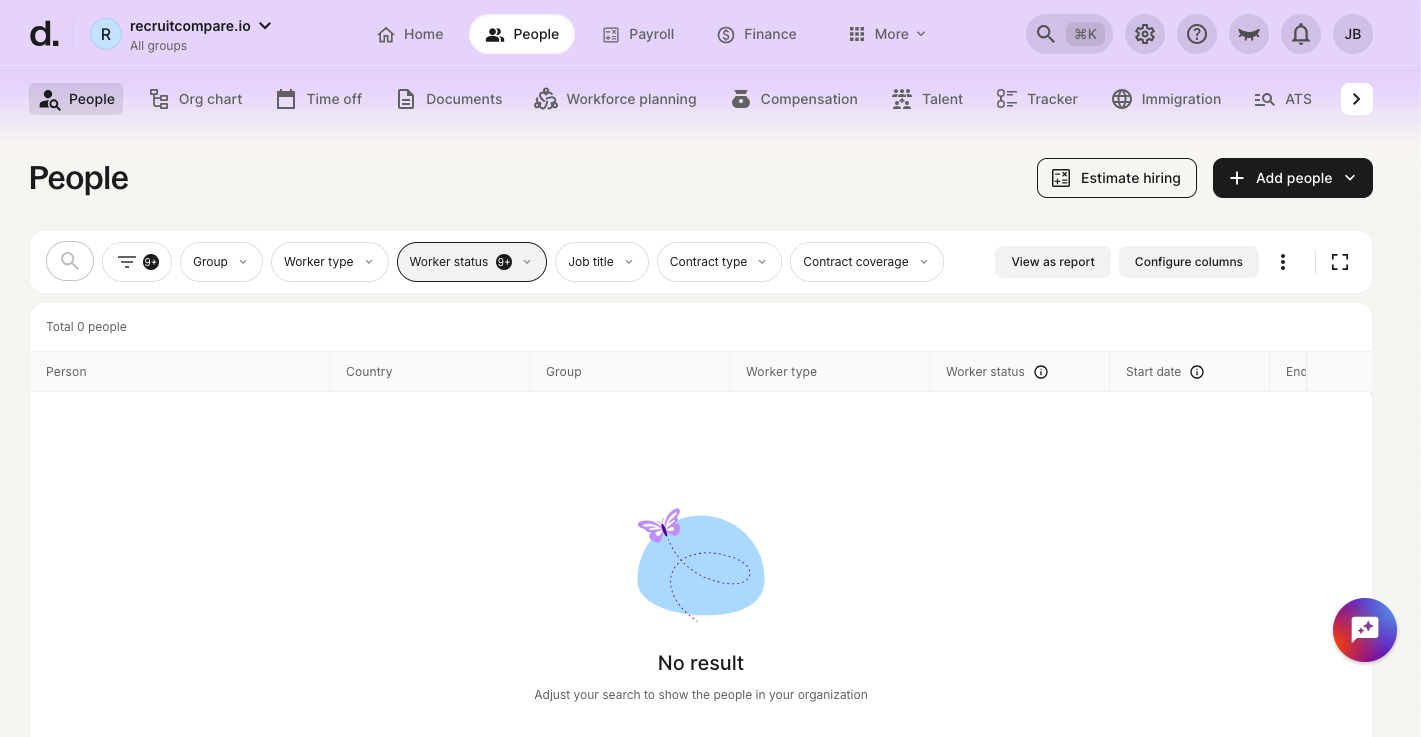 The People section is where you manage all contractors and employees — with filters for worker type, status, contract type, and country.
Employer of Record (EOR) — $599/employee/month
The EOR service is Deel’s core paid product. It allows companies to hire full-time employees in countries where they don’t have a legal entity. Deel — or its local partners, depending on the country — becomes the legal employer on paper, handling payroll, tax withholding, statutory benefits, and employment contracts that comply with local labour law.
This is the product that makes Deel strategically valuable for expanding companies. Onboarding a new employee through Deel’s EOR can be completed in days rather than the weeks or months required to establish a foreign subsidiary. For a company testing a new market with its first hire in, say, Germany or Brazil, the EOR model avoids tens of thousands of dollars in entity setup costs and months of legal groundwork.
Global Payroll — $29/employee/month
For companies that already have their own legal entities in other countries, Deel’s global payroll service runs payroll across 100+ countries from a single platform. This is a different use case from EOR: the company retains legal employer status, but Deel handles the operational complexity of calculating local taxes, managing deductions, and ensuring compliance with country-specific payroll regulations.
The $29/employee/month price point makes this the most accessible of Deel’s paid tiers and is competitive with standalone international payroll providers. It’s particularly useful for companies that have outgrown the EOR model in specific countries (by establishing entities) but still want centralised payroll management across multiple jurisdictions.
What Works Well
Country coverage that’s genuinely unmatched. At 150+ countries, Deel covers more jurisdictions than any direct competitor in the EOR and contractor management space. Remote.com, its closest rival, covers 80+ countries. For companies hiring in less common markets across Southeast Asia, Latin America, or parts of Africa, Deel is often the only platform with established local infrastructure in place.
The free contractor plan is a real product, not a lead-generation gimmick. Many platforms offer “free” tiers that are functionally limited to the point of being unusable. Deel’s contractor plan is a genuinely complete solution: compliant contracts, invoicing, multi-currency payments, and basic reporting. Companies can manage dozens of international contractors without paying Deel any subscription fee. This makes it one of the lowest-risk ways to begin hiring internationally.
Compliance automation reduces genuine legal risk. Contractor misclassification, incorrect tax withholding, and non-compliant employment contracts are expensive legal problems that are increasingly being enforced across multiple jurisdictions. Deel’s automated contract generation and country-specific compliance templates reduce these risks meaningfully, particularly for companies without in-house international employment lawyers or local legal counsel in every market where they operate.
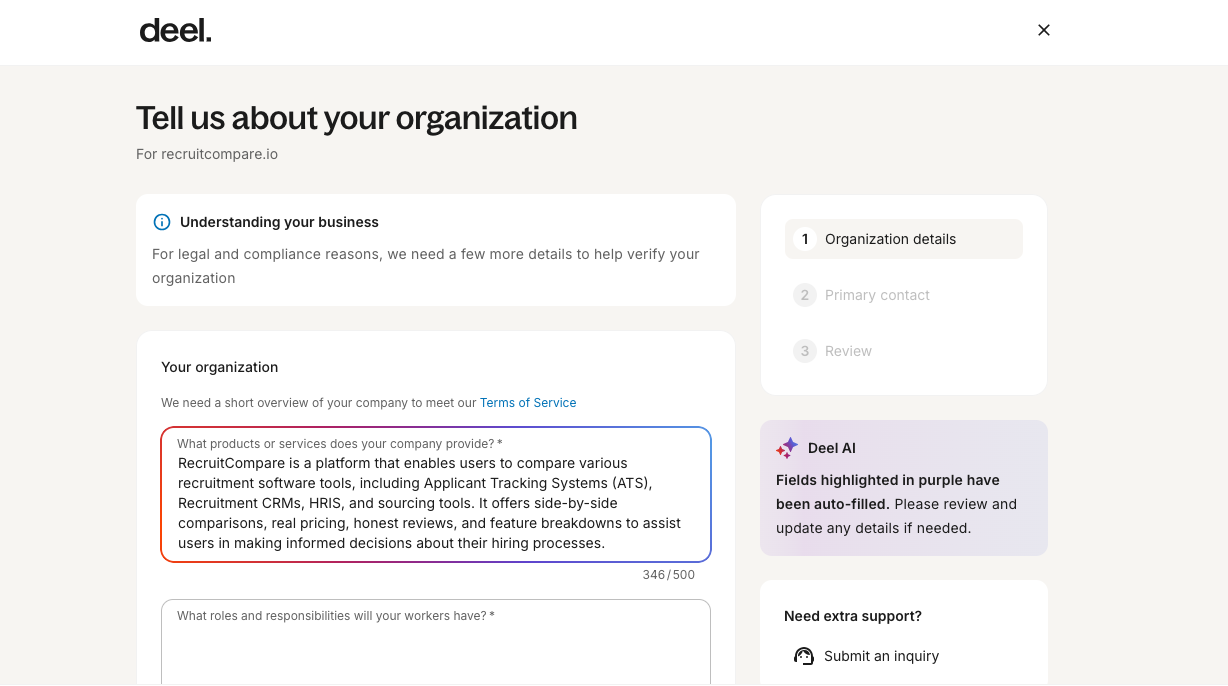 Deel’s compliance onboarding — the platform auto-fills business details and walks you through organization verification step by step.
Fast market entry through EOR. Hiring a full-time employee in a new country through Deel’s EOR service can be operational within days. Establishing a local entity in the same country typically takes months and costs tens of thousands of dollars in legal, registration, and accounting fees. For companies testing a new market with one or two initial hires, the EOR premium — while not cheap — is significantly less expensive than the alternative of full entity setup.
A strong and consistent review profile. A 4.8/5 rating across 4,200+ G2 reviews is difficult to achieve and maintain at that volume. The consistency of positive reviews suggests the platform delivers on its core promises for the majority of its user base, particularly for standard contractor management and EOR use cases.
If you’re evaluating Deel for international contractor payments or EOR services, you can start with the free contractor plan with no commitment to test whether the platform fits your workflow before upgrading to paid tiers.
Where Deel Falls Short
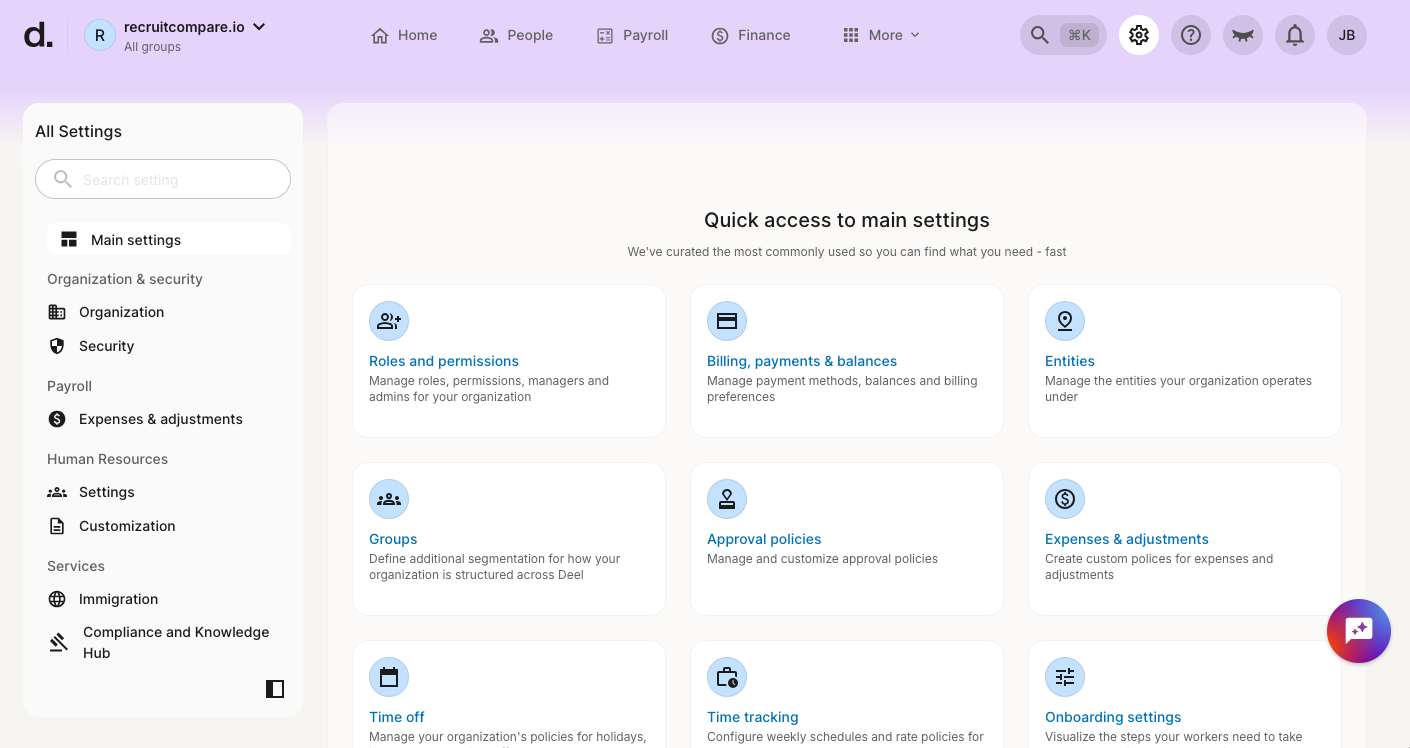 Deel’s Settings panel — organized into Organization, Payroll, HR, and Services sections with quick-access cards for common configuration tasks.
Deel is not a full HRIS — and doesn’t pretend to be. If you need performance management, employee engagement surveys, learning management systems, career development tracking, or people analytics, Deel doesn’t offer any of these. Most companies using Deel end up pairing it with a separate HRIS like BambooHR, HiBob, or Personio for core people operations. This means managing two platforms, two data sources, and the integration overhead between them. It’s a workable setup, but it’s not seamless, and it adds operational complexity that a unified platform wouldn’t require.
EOR costs scale linearly and become prohibitive for larger teams. At $599 per employee per month, the EOR service costs $7,188 per year per employee — on top of their actual salary and benefits. Ten EOR employees in a single country represents $72,000 in annual platform fees. At that scale, establishing a local entity almost always becomes more economical. The general threshold is 5–10 employees per country: below that, EOR makes financial sense; above it, the ongoing fees typically exceed the one-time cost of entity setup. Deel solves the “first few hires in a new market” problem well, but it’s not designed as a permanent, cost-effective employment structure for large distributed teams concentrated in a few countries.
Customer support is adequate for standard cases but struggles with complexity. Standard requests — setting up new contractors, processing routine payments, basic account changes — are handled smoothly. But user reviews consistently flag that complex issues take longer to resolve: tax disputes in specific countries, employment terminations involving local labour law, and edge cases in jurisdictions with unusual regulatory requirements. When Deel relies on local partners rather than its own team for resolution, response quality and timelines can be less predictable.
Variable local partner quality. In some countries, Deel uses third-party partners as the local employer of record rather than operating its own entities. The quality and responsiveness of these partners varies by market. Remote.com has made a competitive point of emphasising that it directly owns more of its local entities, giving it tighter control over the employment relationship and support quality in those markets. For companies evaluating EOR providers, it’s worth asking Deel which countries are served through owned entities versus third-party partners.
Who Deel Is Best For
Based on our analysis across pricing, features, user reviews, and competitive positioning, Deel is the strongest fit for:
- Companies making their first international hires that need compliant employment or contractor arrangements without the cost and complexity of establishing foreign entities
- Startups and scale-ups with distributed teams across 5+ countries where managing local employment law in-house isn’t feasible or cost-effective
- Companies paying international contractors regularly that want a free, reliable, and compliant payment platform with built-in contract generation
- HR teams evaluating EOR providers that need the broadest country coverage available (150+) and the fastest onboarding timeline for new markets
- Finance teams managing multi-currency payroll that want automated tax calculations and consolidated reporting across jurisdictions
Deel is a specialist tool positioned for companies whose primary challenge is the complexity of hiring and paying people across borders. It excels in that specific context and should be evaluated accordingly.
Who Should Look Elsewhere
Deel isn’t the right tool for every hiring scenario. Here are specific cases where other platforms serve the need better.
US-only companies needing domestic payroll. If your entire team is US-based, Deel’s global infrastructure isn’t relevant to your needs. Gusto or OnPay provide simpler, more affordable domestic payroll with better benefits administration features for US companies.
Companies needing a comprehensive HRIS. If performance management, employee engagement, organisational charting, and people analytics are core requirements, look at Rippling for a unified HR-IT-finance platform, or BambooHR and HiBob for dedicated HRIS solutions. Deel doesn’t cover these areas and isn’t planning to. For a detailed comparison of these different approaches, see our Deel vs Rippling analysis.
Companies scaling past 5–10 EOR employees per country. At $599/employee/month, the maths shifts at this threshold. Establishing a local entity in countries where you have a concentrated team becomes more cost-effective. Consider consulting with international employment lawyers about entity setup costs in your target markets before committing to long-term EOR fees.
Teams that prioritise hands-on, dedicated support. If your international employment situations frequently involve complex or unusual circumstances — uncommon visa arrangements, employment terminations in legally complex jurisdictions, edge-case tax scenarios — Remote.com may be a better fit. They emphasise directly owned local entities and more hands-on support for employment law questions in each market. See our best EOR services guide to compare options.
Deel Pricing Breakdown
Deel’s pricing is more transparent than most competitors in the global employment category. Here’s what each tier costs based on our current research.
| Plan | Price | What’s Included |
|---|---|---|
| Contractors | Free | Compliant contracts in 150+ countries, invoicing, multi-currency payments |
| Employer of Record | $599/employee/month | Full legal employment, local payroll, tax compliance, statutory benefits |
| Global Payroll | $29/employee/month | Payroll processing in 100+ countries for companies with their own entities |
| Immigration | Custom (per case) | Visa sponsorship, work permit support, relocation assistance |
All plans include access to Deel’s platform, API, and integrations with tools like Slack, BambooHR, QuickBooks, and Okta. There’s no free trial for paid tiers, but the free contractor plan provides a functional way to evaluate the platform’s interface and core capabilities before committing to EOR or payroll services.
One additional cost consideration: Deel earns margin on currency conversions for international payments. These rates are competitive but not zero — factor them into your total cost of ownership if you’re processing high volumes of international contractor payments.
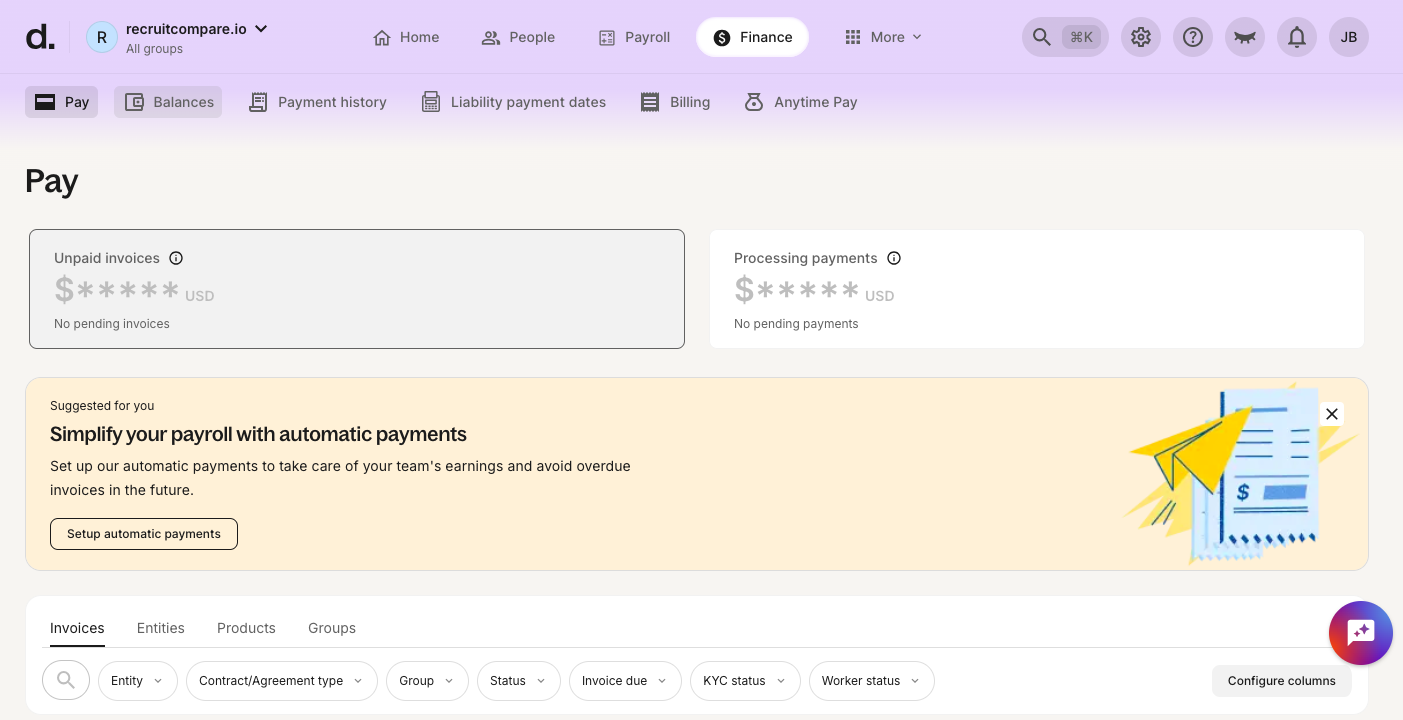 The Finance section handles payments, invoices, and billing — with options for automatic payments and detailed filtering by entity, contract type, and status.
The Bottom Line
Deel is the market leader in global employment infrastructure for a reason: no competitor matches its combination of country coverage (150+), a genuinely free contractor management plan, and automated compliance across jurisdictions. The 4.8/5 rating across thousands of reviews is earned, and the platform delivers on its core promise of making international hiring operationally simple.
But Deel is a specialist tool, not a generalist platform. It excels at international hiring and falls short as a general-purpose HR solution. The EOR pricing is appropriate for strategic, small-scale international hires but becomes prohibitive when teams grow in a single country. Customer support handles routine cases well but can be slow on complex edge cases. And you’ll almost certainly need a separate HRIS for the people operations functions that Deel doesn’t cover.
For companies whose primary challenge is hiring and paying people across borders — particularly those making their first international hires or managing contractors in multiple countries — Deel belongs at the top of your evaluation shortlist. For everything else, other tools serve the need better. See our guides to the best EOR services and best international payroll software for the full competitive landscape.
Ready to evaluate Deel for your team? Start with the free contractor plan — it’s the lowest-risk way to assess the platform before committing to paid services.
Related on RecruitCompare
Get more insights like this
We publish practical guides on choosing and comparing recruitment software. No spam, just useful content.
You're subscribed! Check your inbox.